
Why I Smiled

Last year, I was on a Zoom call with another writer and poet who wrote about her experience as an adoptee. I wanted her opinion on organizing my own memoir and how she went about structuring hers. She described the process of going to editors and how they wanted to structure her narrative. She rejected them all. She basically described that her story organically evolved and structured itself. I felt disappointed. I had written a few drafts of my own story, and the lack of structure was abundantly clear. I was going to have to create my own structure in my own way. Why was structure important to me? My life appeared to be incoherent, and coherence is what I really wanted, which is why I spent a lifetime in therapy and became a psychotherapist.
Anyway, when I smiled during the call, I think she took my reaction to her and her story in the wrong way. I certainly didn’t mean to belittle her story in any way. Quite the contrary. It wasn’t one of those fake smiles. It was a genuine expression of recognition and connection. I felt a kinship with her, and I expressed what I would call a smile of recognition. Kind of like “Oh, hello there, friend that I haven’t met.” I recognized the absurdity of it all. But I couldn’t articulate my response that way at the moment. When she noticed that I was smiling and asked me about it, I said that it was about the absurdity of it all, which wasn’t quite a complete answer.
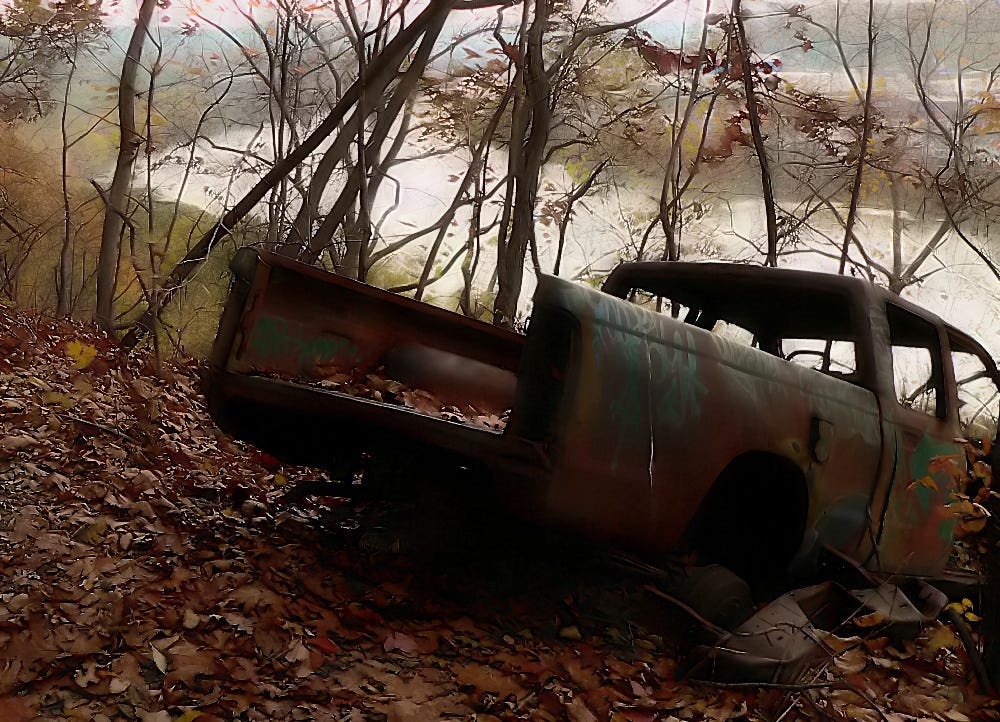
The absurdity was how much I related to her story. It was the same absurdity Kurt Vonnegut describes in his novel Slaughterhouse Five or The Children’s Crusade. Vonnegut understood absurdity because he witnessed the aftermath of the bombing of Dresden during WWII as a POW made to carry dead bodies to the makeshift morgue of the slaughterhouse. I identified with that story and the woman’s to the point of questioning my own connection to it. Why did I identify with her and other adoptees so much? Why did I graduate with a degree in Advertising and Journalism only to have abandoned that path? Why did I identify with the abandoned truck that I photographed so many years ago in my process of healing and self-discovery? That’s what photography gave me. I love that picture.
The answers aren’t so hard to comprehend. My mother was an adoptee, raised by her grandmother. I recognized the pain and anger in the author. She was too much like my mother. But she was also like me. I had attended the Zoom meeting because I discovered late in life that my father was not who I believed him to be. I experienced what some have called a non-parental event or misattributed parentage. I was the child of another unknown man. I saw a part of myself in the author and in my mother. To be sure, there are huge differences. She was a white female; I am a white male. Yet I experienced this amorphous sense of disconnection in childhood that I could not articulate let alone understand. There’s a loss of identity and body autonomy that I had that I hear in others who have been through some other traumatic events. But I had no clue what that event was in my life, really. Oh, I knew about my mother’s violent alcoholic rages and blood-curdling screams in the middle of the night in my childhood. But I didn’t think that made much of a difference. I didn’t see the connection between my experience at home and my mediocre academic performance. I simply blamed myself, as many children do, for not being assertive enough when faced with an absurd world beyond their control. Something was more wrong with me than my family and the world. I took the blame, mostly. I should have studied harder and not have been so lazy. I shouldn’t have needed to disconnect to soothe my body and soul as a child by isolating and watching hours upon hours of television in the 1960s and 70s.
So, that’s why I smiled. And that’s why I smile whenever I hear stories like mine. A part of me knows your story too well. And now you know a little about mine. This is why we share our stories for coherence. We learn more about ourselves and we grow. It may even make you smile too.
I wonder how shared stories have helped you to make sense of your own world, my dear friends?