
When Time Breaks
Revisiting Slaughterhouse Five

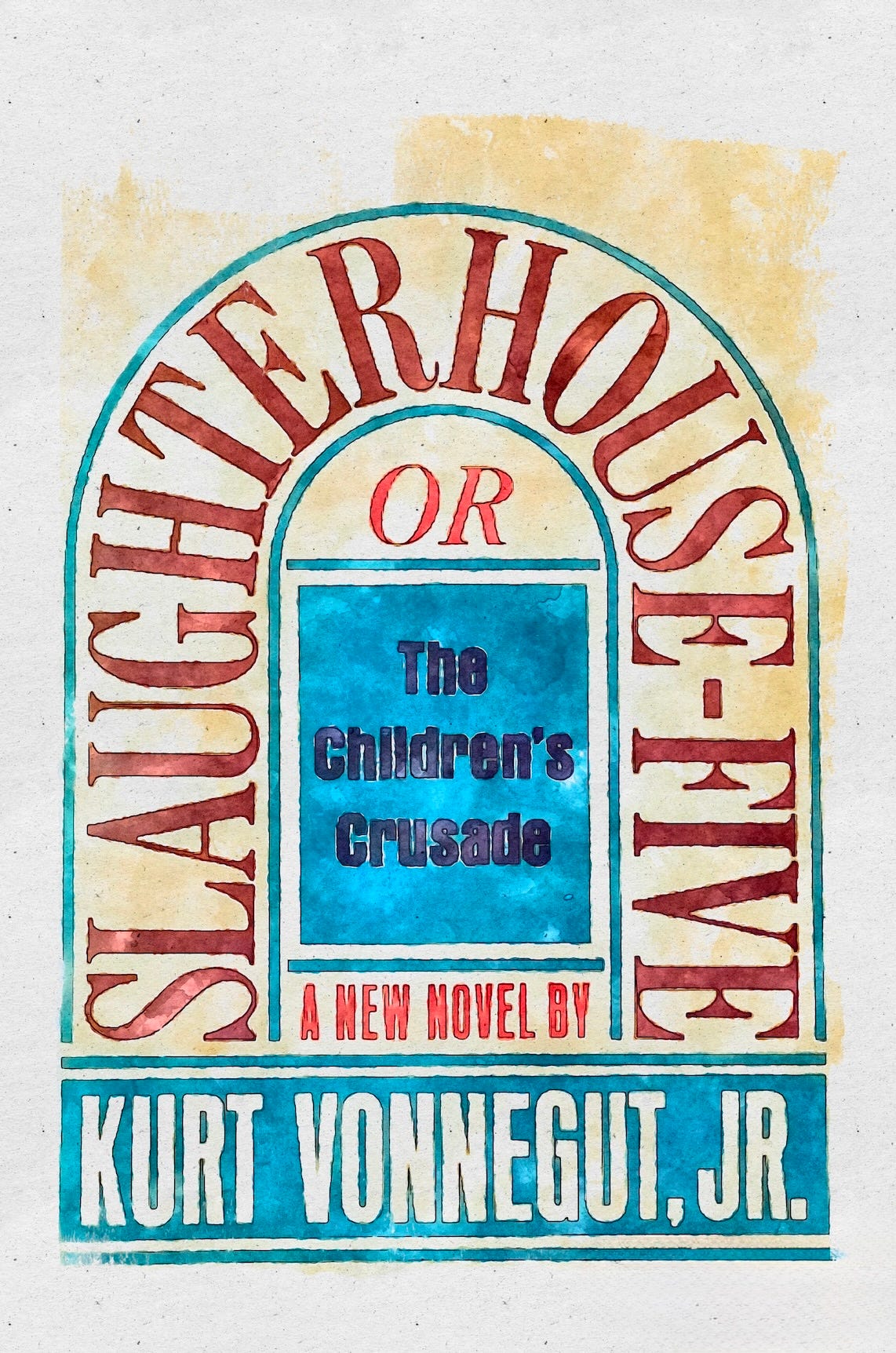
I’ve sat in a room with people for many years now and listened to the way they tell their stories. Not just what happened, but how those experiences are organized, remembered, and carried forward. Most narratives, even when painful, retain a kind of continuity. One moment leads to the next. A self moves across time, integrating experience into something resembling a coherent whole.
But not all stories unfold this way.
Some arrive in fragments. A moment from decades ago surfaces with the immediacy of the present. It’s more of a mosaic. There is no clear beginning or end—only isolated scenes, revisited rather than remembered. In these instances, it’s not just the content of the story that has been disrupted, but the structure that holds it together.
In developmental psychology, we often refer to this structure as scaffolding—the internal and external supports that allow a person to organize experience, regulate emotion, and construct a stable sense of self over time. When that scaffolding is intact, even difficult experiences can be integrated. When it is absent or inconsistent, development becomes disoriented.
And in some cases, the scaffolding holds… until it encounters something it was never designed to bear.
Kurt Vonnegut’s Slaughterhouse-Five introduces Billy Pilgrim as a man who has become “unstuck in time,” drifting unpredictably between moments of his life. This is often read as absurdist fiction—a stylistic reflection of the chaos of war. But there is another way to understand Billy Pilgrim. Not as a man unbound by time—but as a man whose internal scaffolding has collapsed under the weight of an experience he could not fully process.
The firebombing of Dresden represents that collapse. Like the boys in Lord of the Flies, who are stripped of external moral guidance, or Holden Caulfield in The Catcher in the Rye, who confronts a world of inconsistent and unreliable adult anchors, Billy encounters something different. His scaffolding is not gradually eroded or absent—it is overwhelmed. The scale of destruction, the randomness of survival, and the confrontation with mass death does not just shatter his expectations of the world, but his capacity to organize experience within it.
When scaffolding collapses in this way, development does not simply stop. It reorganizes itself.
Billy’s experience of being “unstuck in time” can be understood as an adaptive restructuring. Rather than moving linearly through his life, accumulating and integrating experience, he moves laterally—entering moments without continuity, leaving them without resolution. This fragmentation protects him from sustained emotional overwhelm. No single moment needs to be fully processed because no moment is ever fully stayed in.
What appears as disorientation is, in many ways, a form of regulation. Of protection.
This adaptive structure is reinforced through Billy’s repeated refrain: “so it goes.” Often interpreted as dark humor or existential resignation, the phrase functions as a form of emotional containment. Each time death appears—whether mundane or catastrophic—it is met with the same linguistic response. The repetition flattens the emotional landscape, preventing any single loss from demanding more psychological engagement than he can tolerate. It’s not indifference. It’s economy. A way of managing exposure to overwhelming reality.
The Tralfamadorians, the extraterrestrial beings who perceive all moments as existing simultaneously, further illustrate this adaptive reconstruction. Their philosophy removes urgency, eliminates causality, and reframes death as a minor event in an eternal sequence of moments. Within this worldview, nothing is truly lost, so nothing requires the process of deep mourning. For Billy, this offers a kind of psychological refuge—a system in which the unbearable does not need to be integrated because it is no longer singular or final.
In developmental terms, this is a replacement scaffolding. But it is a structure built for survival, not growth. A mind finding ways to step outside what it cannot yet hold.
Unlike Holden Caulfield, who resists a world he experiences as morally hollow, or Ralph, who struggles to maintain a fragile moral order in the absence of adults, Billy relinquishes the expectation that the world can be made coherent at all. His passivity, often interpreted as weakness, can instead be understood as adaptation. In a context where agency offers no protection—where survival is arbitrary and destruction indiscriminate—assertion loses its function. What remains is a form of psychological withdrawal, a quiet disengagement from the burden of making meaning.
But this adaptation comes at a cost.
Scaffolding is not only what allows us to survive experience—it is what allows us to build from it. It creates continuity, and with continuity comes the possibility of growth, agency, and identity. Billy’s reconstructed world protects him from the full weight of what he has witnessed, but it also isolates each moment from the next. Without continuity, there is no accumulation. Without accumulation, there is no development in the traditional sense.
He survives, but he does not move forward.
In this way, Slaughterhouse-Five extends the psychological terrain explored in Lord of the Flies and The Catcher in the Rye. In some lives, scaffolding is removed before it can fully form. In others, it is present but unreliable, leaving the individual to question the very structures meant to guide them. And in some, it holds—until it encounters an experience that exceeds its capacity entirely.
Billy Pilgrim is not simply a man unstuck in time.
He is a man reorganized around what he has survived.
And his story forces us to confront a difficult question: when the structures that allow us to make sense of our lives collapse, what replaces them—and what kind of self is left to inhabit what remains?
The mind will always find a way to survive. The more difficult question is whether it can still find a way to build a life—rather than simply live through one.
Letters from a Psychotherapist is a reader-supported, ad-free publication. When you subscribe, you’re directly supporting this work and helping keep it independent and accessible.
I’m grateful you’re here.