
Psychotherapy & Euler’s Method
Getting You Closer to Where You Want To Be

Recently, I found myself in a dialogue on Substack with someone who was learning to love math and something called “the Euler method” later in life. I wrote that in therapy, helping clients tackle emotional or psychological challenges is like breaking down a complex problem into smaller, manageable steps, not unlike that mathematical idea. We don’t have all the answers upfront but guide clients toward solutions, adjusting along the way. A big part of therapy is helping clients reframe their perspectives and define their own solutions, whether it's healing from trauma or navigating life changes. It’s not just about solving the issue but figuring out where to begin, similar to setting up a problem in math or physics.
That exchange sparked some memories for me. As a child, I struggled with numbers, their abstract meaning always just beyond my grasp. The long row of zeros on the blackboard stretched endlessly before me, a reminder of how far away I felt from understanding and connection, like distant planets in our solar system. How did they relate to my life? I felt the same way about the game of chess. One of my best friends in grade school would always trounce me. I would plead with him to end his torture and to play beanbag toss or any other simpler game. And though I loved Science, Math and Physics never really caught on with me. I had other strengths.
As I grew older, I discovered that understanding human experience wasn't necessarily about immediate answers or perfect solutions—it was about the gradual process of working through complexity, step by step, moment by moment. Therapy, much like the way I eventually came to understand my own struggles, is not about an instantaneous magical transformation. It's about slowly, methodically, and thoughtfully navigating the intricate pathways of the mind and spirit, more like the story of the tortoise and the hare of Aesop's Fables. Slow and steady progress, not perfection.
This is where Euler's method comes in.
My first therapist happened to be a math teacher who taught disadvantaged kids in challenging neighborhoods. A brilliant woman, she never brought math into our sessions, but she had an understanding of how to interact with apparently insurmountable issues. She also encouraged me to honor my curiosity and to mindfully explore other avenues of growth and development outside of individual psychotherapy. Euler's method is a technique used to solve complex problems, like the curvature of a falling object in changing gravity, that seem too complex to resolve all at once. It works by breaking a problem into small, manageable steps—essentially approximating the solution, one tiny step after another.
Perhaps the most familiar example I can think of for this step-by-step approach in our ordinary daily lives is the GPS navigation system in our cars or smartphones. When we set a destination, the GPS doesn't just show us a static map—it constantly recalculates our route as we move forward, accounting for wrong turns, unexpected stops, or traffic conditions. Each recalculation represents a new approximation, a new step on our seemingly impossible journies.
In therapy, like with GPS navigation, our path to healing isn't fixed or predetermined. When we encounter obstacles, process difficult emotions, or gain new insights about ourselves, our therapeutic journey “recalculates” to bring us closer to where we want to be.
The destination—greater self-understanding and well-being—remains the same, but the path adjusts to our unique experiences and pace. Sometimes life doesn't go according to our plans. We take wrong turns or need to make unexpected stops, but the process continues to guide us forward, one recalculation at a time.
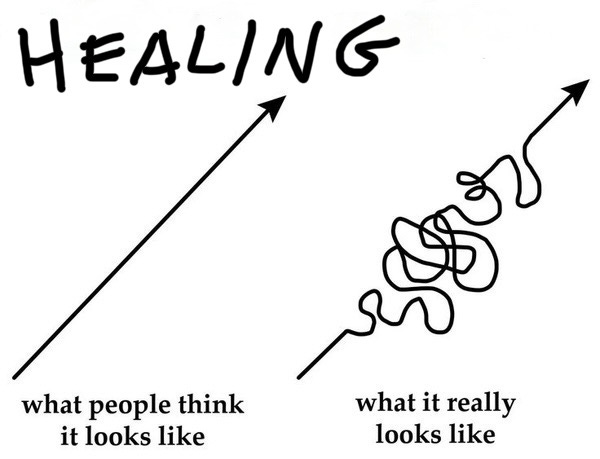
When we apply this idea to psychotherapy, we understand that, like those complex numbers I struggled with as a child, our emotions, thoughts, and traumas don't often resolve quickly, and the process is usually not linear, but curved in various ways. And through therapy, we can approach our issues methodically, with each small step we take moving us closer to understanding ourselves and healing. We will have triumphs and setbacks along the way.
When I started my own circuitous journey through therapy back in the late 1980s, it wasn't with grand revelations right away. Instead, it was like Euler's method, where each session, each realization, each moment of self-awareness was another step forward, another chapter in a story, another leg of the journey. I often felt lost and wasn't where I wanted to be in my life. Just as I now learn how to trust the GPS (or not) to guide me even when I can't see the entire route at once, I eventually came to trust the therapeutic process to lead me toward healing, even when I couldn't immediately understand where each session was taking me. I learned to trust my own unique process of growth and development.
What I've come to realize is that we don't necessarily need advanced degrees in math or physics to grow and heal into the people we want to become. Just as I struggled with numbers as a child yet can find meaning in Euler's method later in life, we don't need to fully understand the theoretical underpinnings of therapy to benefit from its process. You likely don't need yet another intellectual or spiritual certificate. The beauty of both Euler's method and therapy lies in their accessibility—we simply need to take that next step, then the next, trusting that each small movement forward is bringing us closer to our destination. We build trust over time with our humanness. The complexity of the underlying theories matters less than our willingness to engage with the process itself. And then who knows where that might lead us?
Much like Euler's method, where the solution slowly approaches a more satisfying answer, therapy helps us inch closer to a deeper sense of self and healing, even if we don't fully grasp the complexity of it all at once.
Therapy doesn't promise immediate answers, and it shouldn't, but it does provide a path forward on life’s journey. And just like the steps in Euler's method, each move we make is one step closer to the whole picture, even if we can't always see the full view yet. By engaging in the process, you will get closer to where you want to be.
Deeply and surprisingly moving, J.E.!