
Finding Waldo
How did he even get lost?

*Note- AI detectors will likely scan this as 100% generated by AI. I can assure you it wasn’t. However, I do use LLMs to edit my work, and that is what is picked up.
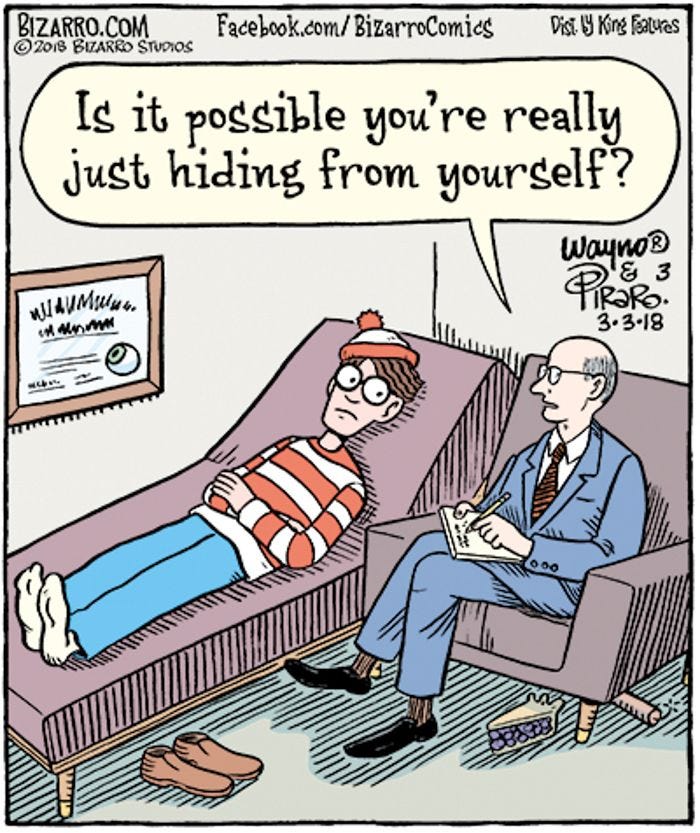
The other day I posted this cartoon on multiple social media platforms. Waldo — that now universally recognized figure in his iconic red-and-white stripes, perpetually lost in a sea of chaotic detail — makes for a fun piece of professional humor. We all relate to him. Stretched out on a therapist’s couch, being gently invited to explore the idea that Waldo might actually be hiding from himself, resonates because good humor carries a kernel of serious truth. While my posting of the cartoon was meant to bring a smile to fellow mental health professionals, it touches on a dynamic that therapists see every day. Many people decide to enter therapy because, much like Waldo, they’re fundamentally unaware of how they may be hiding from themselves, unconsciously undermining their own well-being simply because they do not understand something about who they are.
We often spend a lot of energy hiding in plain sight. We blend into the background of careers, family expectations, and social scripts, becoming masters of adaptation. This camouflage can start early in life as a necessary survival strategy. Long before we have language for any of it, we learn to play Peek-a-boo and Hide ‘n Seek: that disappearing can be a way of staying safe, and that being found is something we can control. In environments where authenticity felt risky, unaccepted, or unsafe, that playful game hardens into a deeper strategy. Keeping parts of oneself tucked away protected the vulnerable ego from judgment or rejection. Over decades, however, these protective layers become second nature, and the game stops being a game. We don’t see it anymore. We move through the world fulfilling roles and meeting external demands, while our own authentic desires, boundaries, and inner voices remain completely obscured. Unconscious. We’re present in our own lives physically, but psychologically, we’re missing — and we are the ones who arranged our own hiding place.
The irony of self-elusion is that the hider always knows where they are, even if they pretend not to. Maintaining that internal distance takes a toll. The exhaustion of keeping oneself at arm’s length frequently manifests as a vague, persistent sense of emptiness, chronic fatigue, or a quiet existential restlessness that defies easy diagnosis. People come to therapy suspecting anxiety, relational friction, or professional burnout. Underneath those presenting concerns often lies something harder to name: they have become strangers to themselves, unable to say with any confidence who they are apart from what the role requires.
This is where a familiar clinical picture — Imposter Syndrome — can take on a different cast. We usually think of it as a mismatch between external success and internal self-doubt. But for someone who has hidden from themselves long enough, the fraudulence isn’t about competence at all; it’s that the competence seems to belong to the role rather than to them. They can perform the part fluently and still feel, underneath it, faint and unaccounted for — as if the person everyone keeps mistaking for them is doing an excellent job of it.
This is where therapy serves a vital purpose. The privacy and containment of a therapist’s office offer something exceedingly rare today — a liminal space free of performance, evaluation, or social obligation. In a curated world constantly demanding productivity and conformity, the therapeutic relationship provides a quiet sanctuary where an individual can finally drop their defenses and just say, f*ck it.
Here, the question of what you’re hiding from ceases to be an accusation or an interrogation. Instead, it becomes an invitation to explore your inner landscape with child-like curiosity rather than shame or embarrassment.
Finding ourselves requires a willingness to welcome back the parts of the personality that were packed away long ago because they were deemed inconvenient, too intense, or unacceptable. It means untangling the self from the roles we play and the expectations we carry. In the safety of a judgment-free space, a person can begin the mindful work of self-discovery, taking off the distracting patterns they’ve worn for years to look at who they actually are underneath those stripes.
But the game doesn’t end there, and I’m wary of any account of therapy that suggests it does. Waldo, found, is still wearing the stripes — that’s the joke, and it’s also the truth. The habit of hiding doesn’t dissolve the moment it’s named; it just loses some of its intensity. Most of what I’ve watched happen in three decades of doing this work isn’t a triumphant unmasking so much as a slower, more modest thing: a person starting to notice, in real time, the exact moment they begin disappearing again, and choosing, this time, to stay.
Therapy is rarely about fixing a broken machine. It’s more often about building the capacity to keep finding yourself, again and again, in a world that keeps asking you to hide.
Letters from a Psychotherapist is a reader-supported, ad-free publication. When you subscribe, you’re directly supporting this work and helping keep it independent and accessible.
I’m grateful you’re here.